You want to learn a new skill. Maybe it’s data science, digital marketing, or cloud computing. You open YouTube, and there are thousands of free tutorials. You scroll through Instagram, and an ad pops up for a paid course promising “job guarantee” and “certification.”
Now you’re stuck. Should you stick with free resources or invest your hard-earned money in a paid course?
This isn’t just a question of budget. It’s about your goals, your learning style, and what you actually want to achieve. After analyzing expert opinions, industry data, and real learner experiences, here’s the complete picture.
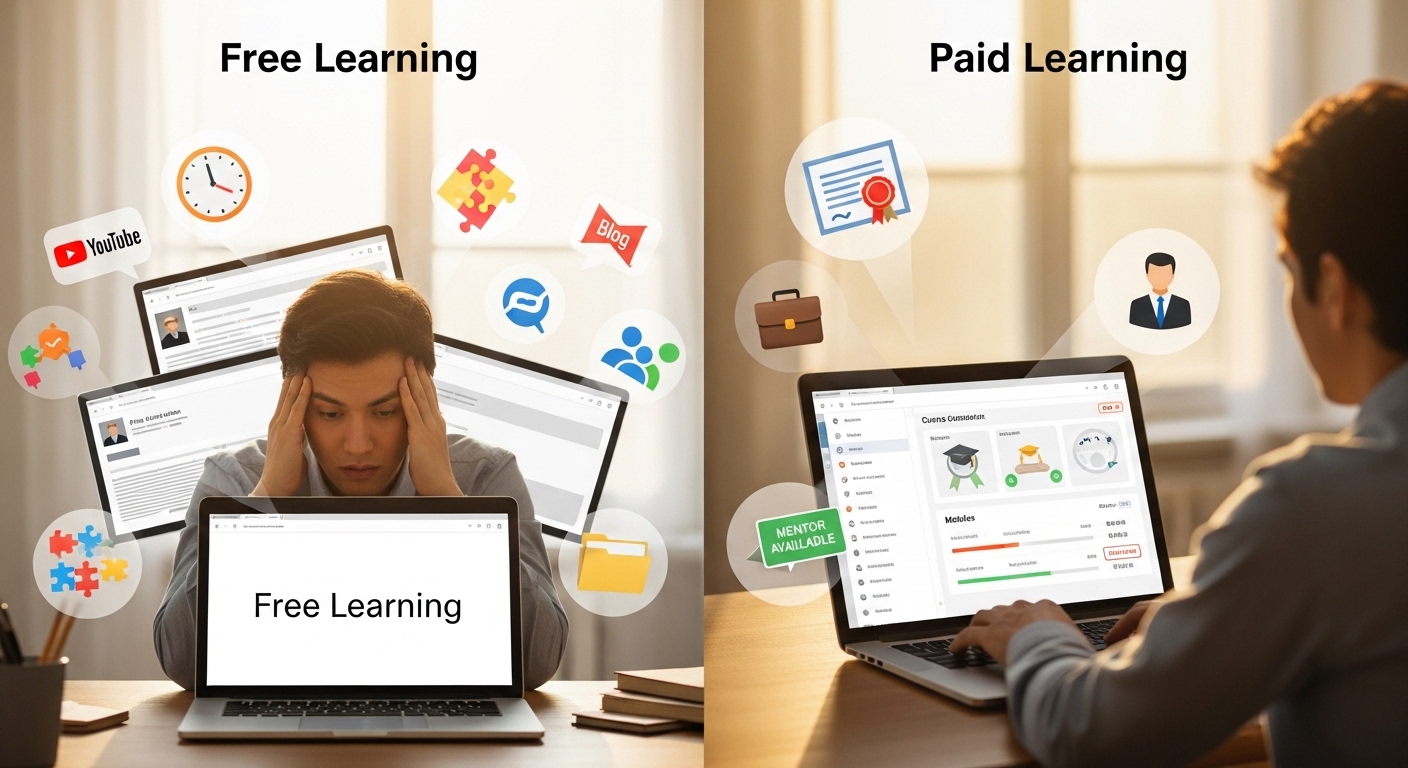
What Free and Paid Courses Actually Offer
Let’s start with an honest comparison. Both options have their place, but they serve completely different purposes .
| Feature | Free Courses | Paid Courses |
|---|---|---|
| Cost | Zero financial investment | ₹500 to ₹1,50,000+ depending on course |
| Curriculum | Basic concepts, often fragmented | Structured, beginner to advanced |
| Mentorship | Community forums (if any) | Expert guidance, doubt-solving |
| Certification | Limited or no recognition | Industry-recognized credentials |
| Hands-on Projects | Mini exercises | Real-world projects, portfolio building |
| Career Support | None | Placement assistance, interview prep |
| Flexibility | Self-paced, no deadlines | Structured schedules with accountability |
| Best For | Exploration, hobby learning | Career advancement, job seekers |
The Expert Verdict: What the Data Says
The Hard Truth About Certificates
A comprehensive study by the Burning Glass Institute analyzed outcomes for more than 23,000 professional certifications and credentials. The finding was sobering: only one in eight non-degree credentials delivered notable pay gains within a year of completion .
Even certificates from elite institutions don’t guarantee returns. Take the Project Management Graduate Certificate from Harvard Extension School—costing $13,760 and taking 18 months to complete. Workers who earned it saw only a 3.7 percentage point increase in career advancement compared to those who didn’t .
So what actually works? The credentials with the best outcomes—adding about $5,000 extra annually within 12 months—were primarily in nursing, radiology, and other medical fields where certifications are widely valued by employers and labor demand is consistent .
Matt Sigelman, president of the Burning Glass Institute, puts it simply: “Credentials can be a very effective way of not only acquiring skills, but validating that you have them.” But he warns that many credentials are “designed based on a loose understanding of what it takes for somebody to get hired in the field” .
When Free Content Is Enough
For certain goals, free resources are not just adequate—they’re superior. Dr. Anant Agarwal, former CEO of edX, argues: “Education should be democratized. The best learning isn’t always behind a paywall” .
Free resources excel when you need :
- Immediate help with a specific task (fixing a router, editing a photo)
- Exploration of a new field without commitment
- Supplemental knowledge to fill gaps in your understanding
- Visual demonstrations (makeup tutorials, DIY repairs)
When Paid Courses Justify the Investment
Paid courses become valuable when you’re serious about career transformation. Dr. Lena Patel, an educational psychologist, explains the psychological advantage: “When we pay for something, we assign it greater importance. A free YouTube video feels disposable. A paid course feels earned. That psychological shift increases engagement and retention” .
Paid programs offer what free content rarely can :
- Structured learning paths that take you from zero to job-ready without piecing together 50 different YouTube videos
- Expert mentorship to answer questions and provide real-world context
- Accountability that keeps you from abandoning the course midway
- Recognized certifications that employers actually trust
- Career support including placement assistance and interview preparation
The Psychology of Learning: Why Free Often Fails
The Completion Crisis
Free courses have abysmally low completion rates. Without financial commitment or external accountability, it’s easy to watch three videos and never return. Paid courses create a psychological contract—you invested money, so you feel obligated to finish .
The Information Overload Problem
With free content, you’re constantly jumping between sources. One YouTube channel teaches Python one way, another teaches it differently. A blog post contradicts a tutorial. You spend more time figuring out what to learn than actually learning. Paid courses eliminate this by providing a single, coherent roadmap .
The Motivation Factor
Dr. Rajiv Mehta, Digital Education Researcher, observes: “The future of learning isn’t free versus paid. It’s curated versus chaotic” . When content is curated by experts who understand how beginners think, learning becomes faster and less frustrating.
Real Stories: What Actually Happens
Sophie’s Journey: From YouTube to MasterClass
Sophie, a 32-year-old graphic designer, spent two years learning photography through YouTube. She mastered technical skills—manual mode, Lightroom presets—but her work felt creatively stagnant. “I could replicate what others did, but I didn’t know how to create something original,” she said .
She subscribed to MasterClass and took Annie Leibovitz’s photography course. The difference wasn’t technical—it was philosophical. Leibovitz discussed building trust with subjects, finding emotional truth in portraits, and developing a visual voice. “She showed me that photography isn’t about capturing light—it’s about revealing character,” Sophie recalled .
The lesson: YouTube taught her how. The paid course taught her why .
Gabriel’s Strategic Investment
Gabriel Sanchez, 38, wanted to switch from higher education to cybersecurity. He enrolled in the University of Colorado, Boulder’s Cybersecurity Certificate in 2023. He was realistic about expectations: “The name of the certificate doesn’t carry any weight the way a master’s degree or even industry certifications do. I knew that this was more to build a set of skills that I can put on a résumé” .
His approach worked. He emphasized his soft skills and the technical vocabulary he learned from the course in interviews—and landed a job in the field. About two or three of his roughly two dozen classmates did the same .
The lesson: He didn’t expect the certificate to work magic. He used it to build skills and then demonstrated those skills effectively .
Platform-by-Platform Breakdown
Coursera: From Free to Freemium
Coursera used to offer most courses for free. Now, you need a $59-per-month subscription or flat fee per course (typically $49 for six months) to access full content. You can “preview” the first module free—usually just an introductory video .
What’s good: University-partnered courses, robust language support, well-designed video player with searchable transcripts, and actual degree programs .
What’s not: The “free” option is now essentially a teaser. The subscription cost adds up if you’re not focused .
MasterClass: Inspiration, Not Instruction
MasterClass costs $120/year and features celebrity instructors—Gordon Ramsay, Martin Scorsese, Serena Williams. Production quality is cinematic, and courses focus on philosophy and mindset rather than technical skills .
What’s good: Unparalleled access to elite minds, beautiful production, perfect for creative inspiration .
What’s not: No certifications, no hands-on exercises, won’t make you job-ready. As one expert notes, “MasterClass doesn’t teach shortcuts—it teaches mindset. That’s what separates inspiration from instruction” .
Udemy: The Mixed Bag
Udemy offers individual course purchases ($20-$150) or a subscription model. Quality varies wildly because anyone can create a course .
What’s good: Huge variety, frequent discounts, practical software tutorials .
What’s not: Inconsistent quality—some courses are thinly veiled infomercials. The “limited time discount” pricing gimmick is misleading .
YouTube: The Free Giant
YouTube remains the largest free learning library. Channels like Khan Academy, CrashCourse, and FreeCodeCamp offer university-caliber content at no cost .
What’s good: Unmatched breadth, immediate access, community comments often add value .
What’s not: No structure, no certification, quality filtering requires effort, algorithm prioritizes engagement over accuracy .
Specialized Platforms
For technical fields like Google Cloud, platforms like CloudThat offer structured paid training. The advantage: exam-specific preparation, instructor expertise, and hands-on labs that mirror real challenges .
The Hidden Costs of “Free”
Your Time Is Money
When you piece together free content from multiple sources, you’re spending hours—sometimes days—just figuring out the learning path. A paid course delivers that path immediately. As one expert puts it, “paid programs could save you months of trial-and-error” .
The Opportunity Cost
While you’re watching random YouTube videos, someone in a structured program is building portfolio projects, getting feedback from mentors, and applying for jobs. The six months you spend figuring things out yourself could be the difference between starting your career now versus next year .
The Credential Gap
Many free courses offer certificates, but they often lack industry recognition. Paid programs from reputable providers carry weight with employers—especially when they include university partnerships or industry certifications .
The Digital Divide: Who Free Learning Leaves Behind
Free online learning sounds like “the great equalizer,” but it still requires reliable internet access and relatively high digital literacy. The pandemic showed that not everyone has these privileges .
Beyond accessibility, there’s the question of bias. Scrolling through Coursera reveals a pattern: humanities courses are often free; STEM courses are expensive. “Hmmm, I wonder what and who is prioritized?” one educator observed .
If we want open education to fulfill its promise, it must be truly inclusive—not just free for those who can already navigate the system .
The Hybrid Strategy: Best of Both Worlds
Experts overwhelmingly recommend a hybrid approach :
Step 1: Start with Free Resources
- Explore the field without financial commitment
- Test whether you actually enjoy the subject
- Build foundational vocabulary and concepts
- Identify which specific area interests you most
Step 2: Identify Your Gaps
- What can’t you learn from free content?
- Do you need structured feedback?
- Is certification important for your career?
- Do you struggle with self-motivation?
Step 3: Invest Strategically
- Choose a paid program that addresses your specific gaps
- Look for hands-on projects, mentorship, and placement support
- Verify instructor credentials and alumni outcomes
- Read independent reviews (not just testimonials on the website)
Step 4: Supplement Continuously
- Use YouTube for quick tutorials when stuck
- Join free communities for peer support
- Keep learning even after the course ends
Decision Framework: Which Path for You?
Choose Free Courses If:
- You’re exploring a new interest and unsure about commitment
- You need quick help with a specific, well-defined task
- You’re highly self-motivated and good at creating your own structure
- You’re supplementing existing knowledge with niche techniques
- Certification and career support don’t matter for your goals
Choose Paid Courses If:
- You’re serious about career advancement or switching fields
- You need structured guidance to avoid getting lost
- You want recognized certification that employers trust
- You benefit from mentorship, feedback, and accountability
- You’re aiming for job placement and want career support
Consider University Certificates If:
- You need credentials that carry academic weight
- You’re planning further formal education
- Employer in your field specifically values university affiliations
But be realistic: Even Harvard Extension School certificates don’t guarantee pay raises .
Red Flags: When to Avoid a Paid Course
Not all paid courses are worth your money. Watch for these warning signs :
- Vague promises like “become a millionaire in 6 months”
- No verifiable instructor credentials—who are they and what have they actually done?
- No transparent outcomes—they won’t share placement data or alumni reviews
- Pressure to buy now with fake urgency (“only 3 seats left!”)
- No money-back guarantee or reasonable refund policy
- Curriculum that’s just a list of topics with no depth or structure
The Bottom Line: Expert Consensus
After reviewing all the evidence, here’s what the experts agree on :
Free courses are for exploration. Paid courses are for transformation.
- Use free resources to discover what you want to learn
- Use paid programs to master it and turn it into a career
Matt Sigelman’s advice for anyone considering a credential: “Read job postings and identify the in-demand skill set for your desired positions—whether that is project management, data analysis or social-media marketing” . Then choose a program that actually teaches those specific skills.
Gabriel Sanchez, the cybersecurity student who successfully switched careers, offers the perfect mindset: He didn’t expect the certificate to work magic. He used it to build skills and then demonstrated those skills effectively in interviews .
The final word: “Credentials can be a very effective way of not only acquiring skills, but validating that you have them” . But they’re tools, not magic wands. Your effort, your portfolio, and your ability to demonstrate what you’ve learned matter more than the piece of paper at the end.
Choose wisely. Learn actively. Apply consistently. That’s the real formula—whether you pay or not.
About the Author
