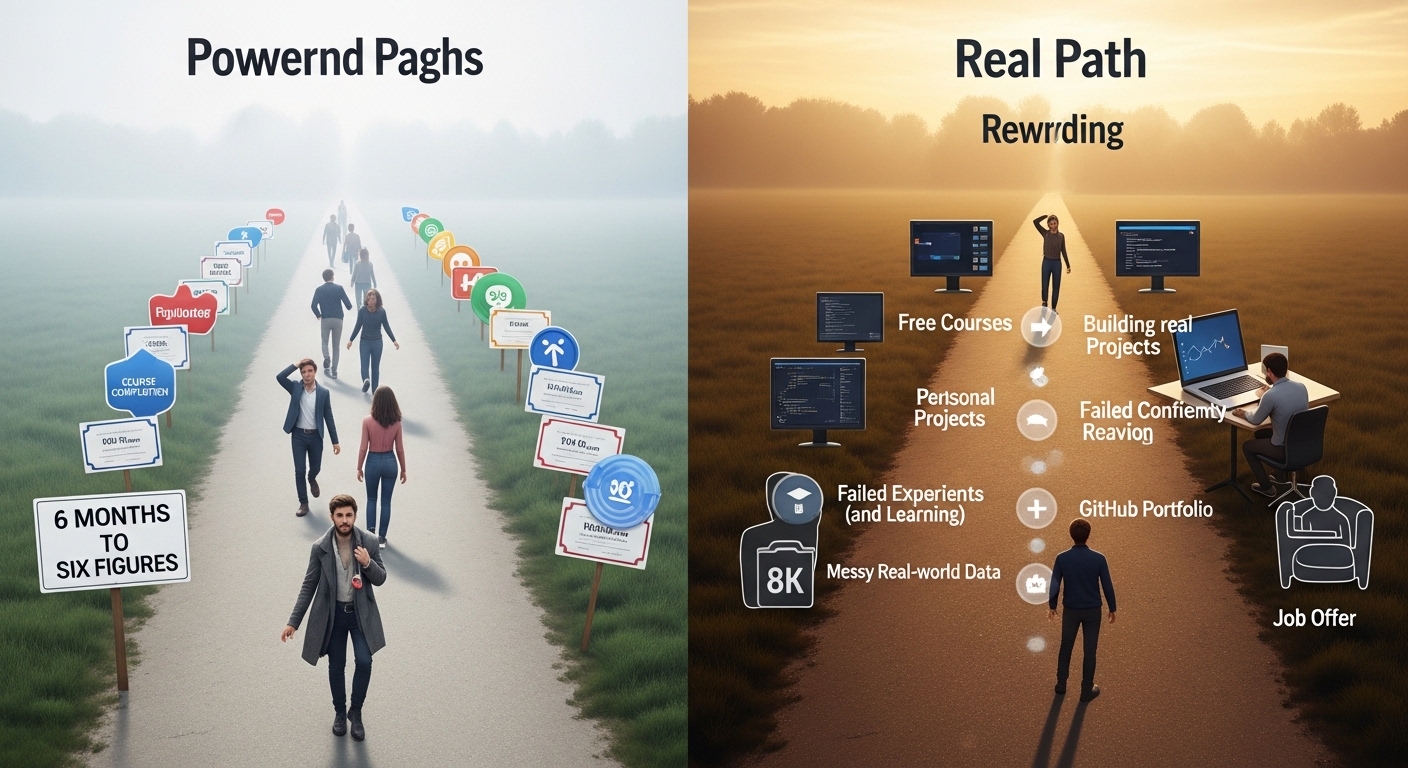
Data Science is everywhere. “Sexiest job of the 21st century.” “Six-figure salaries.” “Work in AI, ML, and cool tech.” The hype is real, and thousands of students are signing up for courses every single day.
But here’s the uncomfortable question: After spending ₹50,000 to ₹3,00,000 on a course, will YOU be the one who gets hired?
The dirty secret of the ed-tech industry is that they sell you the dream, but they don’t tell you the whole truth. They show you the 1% who made it, not the 99% who are still struggling with the same confusion you have today.
Let me share the 5 truths no one tells you about data science courses—truths that will save you time, money, and heartbreak.
Truth #1: The Course Alone Won’t Get You Hired — Your Thinking Will
What they tell you: “Complete this 6-month course, and you’ll be job-ready. Companies will line up to hire you.”
The reality: The industry doesn’t hire you for knowing Python or completing a certification. They hire you for solving problems that matter .
Here’s what actually matters to employers:
- How you analyze messy, real-world data (not clean CSV files from tutorials)
- How you build end-to-end pipelines (not just Jupyter notebooks)
- How you think when data is missing or wrong
- How you design ML systems that actually work in production
- How quickly you adapt and learn when things break
The hard truth: You’re taught to study, not to think. You’re shown notebooks, not systems. You’re taught theory, not execution. And then when interviews come, you feel lost—because interviewers don’t ask “What is Random Forest?” They ask: “How will you build something real with it?”
Truth #2: Free Courses Can Teach You 80% of What You Need
What they tell you: “You need our structured paid program with certifications to succeed.”
The reality: Some of the best data science learning is completely free .
| Free Resource | What You Can Learn |
|---|---|
| Google Data Analytics Certificate (Free Tier) | Analytics, visualization |
| IBM Data Science Professional Certificate (Free Trial) | Python, SQL, ML with projects |
| Microsoft Learn | Python, R, Azure tools |
| upGrad free courses | Excel, Python, MySQL, data visualization |
Free courses are perfect for:
- Exploring whether you actually enjoy data science
- Building foundational skills without financial commitment
- Testing multiple topics before specializing
The catch: Free courses lack mentorship, recognized certifications, and career support. But for learning the actual skills? They’re often just as good as paid options .
Truth #3: Certificates Are Worthless Without Demonstrated Skills
What they tell you: “Our certification is recognized by top employers and will make your resume stand out.”
The reality: Certifications are okay as motivation, but they are NOT a differentiator in the market. Thousands of people have the exact same certifications .
What actually gives you a competitive advantage?
- Real projects you can talk about in interviews
- Code on GitHub that shows your thinking process
- Internships (even unpaid) where you solved actual business problems
- A portfolio with no more than three master projects that truly represent your level
The truth: Every recruiter knows that certificates can be memorized and passed. They want to see what you can DO, not what you can PASS.
Truth #4: Most of Your Time Will Be Spent on Failures — And That’s Normal
What they tell you: “Follow our step-by-step curriculum and everything will work perfectly.”
The reality: Data science is fundamentally an experimental process. Most experiments are failures and dead ends—and that’s not failure, it’s simply part of the work .
Even people who have worked with data for years deal with:
- Experiments that don’t lead anywhere
- Ideas that completely fail
- Results that don’t make sense at first
The comforting truth: It’s normal. It doesn’t mean you’re doing something wrong. What matters more is learning how to ask better questions and understanding your goals before focusing on techniques .
Truth #5: Domain Knowledge Matters More Than Fancy Algorithms
What they tell you: “Learn the latest algorithms—XGBoost, Neural Networks, Transformers—that’s what employers want!”
The reality: Too often, data scientists present findings to business people, and the reaction is: “We already know this” or “This is nonsense because that’s not how our business works” .
A data scientist solves business problems, not technical problems. You have only as much value as the value of your solution. And you can only create valuable solutions when you understand the business .
What actually matters:
- Half your learning should be industry and business knowledge
- Understanding why something happens, not just what happened
- Knowing how to translate business questions into data questions
The Bottom Line: Should You Take a Data Science Course?
Yes, if:
- You’ve already explored free resources and know you love the field
- You choose a course that emphasizes projects over theory
- You’re committed to spending at least as much time on personal projects as on coursework
- You understand that the course is just the beginning, not the end
No, if:
- You think a certificate alone will get you a job
- You’re not willing to spend months (or years) practicing and building
- You’re looking for a “shortcut” to a high salary
- You haven’t even tried free resources yet
What You Should Actually Do
- Start with free resources — Google, Microsoft, and IBM all offer excellent free tiers
- Build real projects — Even small ones. Take someone else’s code, apply it to different data, alter it, break it, fix it
- Focus on depth, not breadth — Better to deeply understand regression than to superficially know 20 algorithms
- Develop domain knowledge — Pick an industry and become an expert in how it works
- Be consistent — Learn a little every day, not a lot once a month. This is a marathon, not a sprint
Remember: You don’t have to be a genius to get into data science. You just need to learn what actually matters. Spend less time chasing courses. Spend more time building, experimenting, debugging, breaking things, and understanding the WHY behind every decision .
That’s how you become the 1% who actually get callbacks.
About the Author
