The UPSC Civil Services Examination is arguably India’s toughest exam. Lakhs of aspirants appear every year, but only a few hundred make it. The journey is long, demanding, and often lonely.
One of the first decisions you’ll face: Should I join online coaching or traditional offline classes?
Both have passionate advocates. Online supporters praise flexibility and affordability. Offline loyalists swear by discipline and peer learning. The truth? Neither is universally “better.” The right choice depends entirely on you—your learning style, circumstances, and goals.
Let’s break down everything you need to know to make this decision.
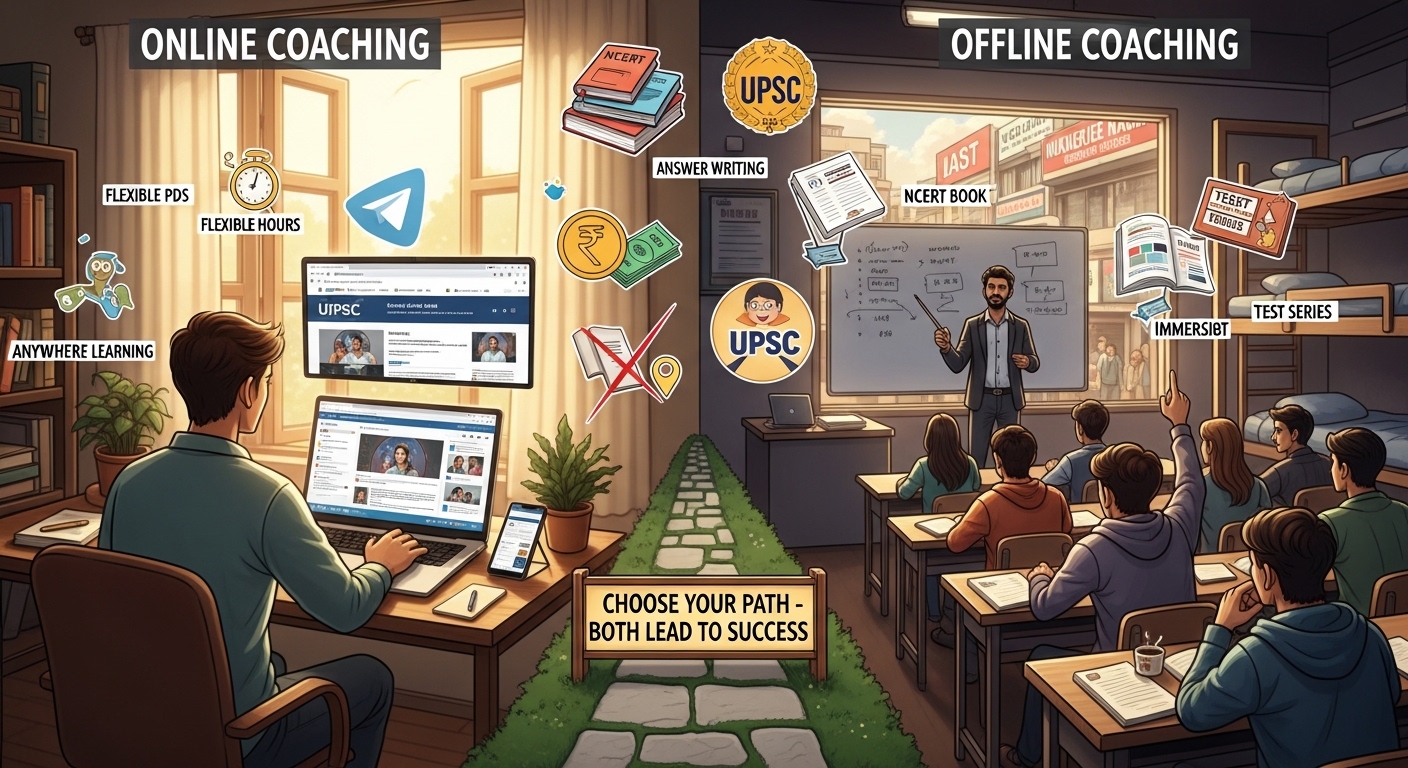
The Case for Offline Coaching: The Traditional Path
The Delhi Dream (and Reality)
Every year, thousands of aspirants move to Delhi, Lucknow, or Prayagraj for UPSC coaching. They live in cramped hostels, spend hours in classes, and breathe UPSC 24/7. Why?
1. The Discipline Factor
For many students, especially those straight out of college, self-discipline is the biggest challenge. Offline coaching imposes structure. You have to wake up, have to attend class, have to be somewhere at a fixed time. This external pressure keeps you on track when your motivation flags.
2. Immediate Doubt Resolution
In a physical classroom, you can raise your hand and get your doubt clarified instantly. No waiting for email replies. No typing out complex questions. Just point and ask.
3. Peer Learning and Competition
Surrounding yourself with serious aspirants creates a powerful ecosystem. You discuss current affairs over chai, debate answer-writing approaches, and learn from each other’s mistakes. This peer pressure can push you to work harder than you would alone.
4. The “Vibe” and Motivation
Being in a coaching hub like Mukherjee Nagar or Rajendra Nagar creates a unique atmosphere. Everyone around you is on the same journey. The struggle is shared. When you see others working late into the night, it motivates you to do the same.
5. Access to Toppers and Mentors
Coaching centers often invite previous toppers for interactions. Being physically present allows you to network, ask questions, and build relationships that can guide your journey.
The Dark Side of Offline Coaching
1. The Cost Bomb
Moving to a metro city for UPSC coaching is expensive :
- Coaching fees: ₹80,000 to ₹2,50,000 depending on the institute and course duration
- Accommodation: ₹5,000-15,000 per month for a shared room
- Food and travel: Another ₹5,000-8,000 per month
- Study material: ₹10,000-20,000 per year
Total cost for a 1-2 year journey: ₹3-6 lakhs easily.
2. The Time Sink
Commuting to and from coaching centers eats precious hours. In cities like Delhi, a 1-hour commute each way means losing 2 hours daily—600+ hours over a year that could have been used for self-study.
3. One-Size-Fits-All Teaching
Classroom coaching moves at a fixed pace. If you’re faster than the class, you get bored. If you’re slower, you struggle to keep up. There’s no rewind button. No watching a difficult lecture twice.
4. Variable Quality
Not all teachers in an institute are equally good. You might join for a famous faculty member, only to discover they take only a few lectures while assistants handle the rest.
5. The Delhi Distraction
Ironically, the same peer ecosystem that motivates can also distract. Endless chai breaks, group discussions that go nowhere, and the pressure to “keep up with the Jonses” can waste precious time.
The Case for Online Coaching: The Modern Alternative
The Revolution in UPSC Preparation
Over the last 5 years, online UPSC coaching has exploded. Platforms like Unacademy, StudyIQ, Vision IAS, and Drishti IAS now offer comprehensive programs that rival—and sometimes exceed—offline options.
1. Learn from the Best, Anywhere
Online coaching democratizes access. A student in a small town can now learn from Delhi’s top faculty without moving. Suddenly, geography is irrelevant. You get the same quality as someone paying lakhs in rent.
2. Flexibility and Convenience
- Watch at your pace: Difficult topic? Watch it twice. Easy topic? Speed it up.
- Learn anytime: Morning person? Study at 5 AM. Night owl? Watch lectures at midnight.
- No commute: Every hour saved is an hour for self-study.
3. Recorded Lectures: The Game-Changer
This is perhaps the biggest advantage. With recorded lectures, you can :
- Pause and take notes
- Rewind and replay complex concepts
- Revise an entire subject by watching key lectures again
- Never miss a class due to illness or travel
4. Lower Cost
Online coaching is significantly cheaper :
- Comprehensive courses: ₹30,000 – ₹1,00,000
- No accommodation, food, or travel costs
- Free or low-cost test series available
5. Structured Digital Material
Most online platforms provide well-organized PDFs, notes, and current affairs compilations. Everything is searchable, accessible on your phone, and never lost.
6. All-India Peer Group
Online platforms connect you with aspirants across the country. Telegram groups, discussion forums, and live doubt-solving sessions create a virtual community that can be just as motivating as a physical one.
The Challenges of Online Coaching
1. Self-Discipline Required
No one’s watching. No one will scold you for skipping a lecture. You’re completely responsible for your own progress. This is the single biggest reason people fail with online learning.
2. Limited Personal Interaction
While doubt-solving exists, it’s not the same as raising your hand in class. You have to type your question, wait for a reply, and hope the explanation is clear. Some nuance gets lost in text.
3. Screen Fatigue
Staring at a screen for 6-8 hours daily can be exhausting. Eye strain, headaches, and reduced retention are real issues.
4. Internet and Technical Issues
In many parts of India, reliable high-speed internet is still a luxury. Buffering during a live class, connectivity drops, and device failures can disrupt learning.
5. Isolation
Studying alone at home can get lonely. Without peers around, motivation can dip. The shared struggle that pushes you forward in a coaching hub is missing.
6. Self-Doubt About “Am I Doing Enough?”
Without constant comparison with peers, some aspirants struggle to gauge their preparation level. You might think you’re doing well, only to discover in tests that you’re behind.
The Decision Framework: Which One for YOU?
Choose Offline Coaching If:
| You Are… | Why Offline Fits |
|---|---|
| Needing external discipline | Classroom structure keeps you accountable |
| Thriving on peer competition | Being around serious aspirants pushes you |
| Learning better through discussion | In-person debates clarify concepts |
| Struggling with self-study | Teachers guide your path |
| Able to afford moving | You can bear the higher cost |
| New to UPSC preparation | Structured hand-holding helps beginners |
Choose Online Coaching If:
| You Are… | Why Online Fits |
|---|---|
| Self-disciplined and motivated | You can manage your own schedule |
| On a tight budget | Save on fees, rent, and living costs |
| Unable to relocate | Family obligations, job, or other constraints |
| Living in a small town | Access Delhi-quality faculty without moving |
| Comfortable with technology | You learn well through digital platforms |
| Prefer learning at your own pace | Rewind, pause, and speed up as needed |
The Hybrid Approach: Best of Both Worlds
Increasingly, successful aspirants are adopting a hybrid strategy :
Option 1: Online Foundation + Offline Test Series
Join an online course for conceptual clarity from top faculty. Then, join an offline test series in your city (or Delhi) for answer writing practice and peer comparison.
Option 2: Offline Coaching + Online Current Affairs
Attend offline classes for static subjects (History, Geography, Polity) but supplement with online current affairs videos and monthly compilations.
Option 3: Recorded Lectures + Live Doubt Sessions
Watch recorded lectures at your pace, but attend live doubt-clearing sessions regularly to stay connected and get your questions answered.
Option 4: The 6-Month Offline Boost
Start with online coaching at home. In the final 6 months before prelims, move to Delhi for intensive test series and peer environment.
Real Stories: What Actual Aspirants Say
The Offline Success Story
Rahul moved from Bihar to Delhi for UPSC coaching. He joined a famous institute in Rajendra Nagar. The first few months were overwhelming—the crowd, the competition, the expensive mess food. But slowly, he found his group. They discussed answer strategies, shared notes, and kept each other motivated during failures. Rahul cleared UPSC in his second attempt. His take: “The environment pushed me when I wanted to give up. I wouldn’t have made it without my peer group” .
The Online Success Story
Priya was a working professional in Bangalore. She couldn’t quit her job or move to Delhi. She joined an online platform and studied from 7-9 AM before work, 8-11 PM after work, and full weekends. She never met her teachers in person, but she watched recorded lectures at 2x speed, revised constantly, and used Telegram groups for peer discussion. She cleared UPSC in her first attempt. Her take: “Online learning gave me flexibility. I could study when I was actually awake, not when the class schedule demanded” .
The Hybrid Success Story
Arjun started with online coaching in his hometown. He covered the syllabus systematically over 8 months. Six months before prelims, he moved to Delhi and joined a test series. The peer environment in Delhi pushed his preparation to the next level. He discovered gaps in his writing that he never noticed while practicing alone. Arjun credits both phases for his success .
Decision Matrix: Quick Self-Assessment
Ask yourself these questions. Score yourself honestly :
| Question | Yes (1 point) | No (0 points) |
|---|---|---|
| Can I wake up at 6 AM and study without anyone pushing me? | ||
| Do I have a quiet, distraction-free space at home to study? | ||
| Is my internet connection reliable for video lectures? | ||
| Am I comfortable with technology (apps, PDFs, online tests)? | ||
| Can I afford the higher cost of moving to a coaching hub? | ||
| Do I have family/ work obligations preventing relocation? | ||
| Do I learn better by discussing with peers face-to-face? | ||
| Have I successfully completed self-study projects before? | ||
| Do I need teachers to keep me accountable? | ||
| Am I willing to live away from family for 1-2 years? |
Interpretation:
| Score | Recommendation |
|---|---|
| 8-10 points | Strong case for OFFLINE coaching |
| 5-7 points | Hybrid approach likely works best |
| 0-4 points | Strong case for ONLINE coaching |
Cost Comparison: The Real Numbers
Offline Coaching (1 Year)
| Expense | Estimated Cost |
|---|---|
| Coaching fees | ₹1,00,000 – ₹2,00,000 |
| Accommodation (shared room) | ₹60,000 – ₹1,20,000 |
| Food | ₹60,000 – ₹1,00,000 |
| Travel (local) | ₹10,000 – ₹20,000 |
| Study material | ₹10,000 – ₹20,000 |
| Test series | ₹10,000 – ₹20,000 |
| Miscellaneous | ₹20,000 – ₹30,000 |
| Total | ₹2,70,000 – ₹5,10,000 |
Online Coaching (1 Year)
| Expense | Estimated Cost |
|---|---|
| Coaching fees | ₹40,000 – ₹80,000 |
| Internet/data | ₹6,000 – ₹12,000 |
| Study material (digital) | ₹5,000 – ₹10,000 |
| Test series (online) | ₹5,000 – ₹15,000 |
| Total | ₹56,000 – ₹1,17,000 |
Savings with online: ₹2-4 lakhs per year.
The Bottom Line: Expert Consensus
After analyzing both options, here’s the balanced truth :
Offline Coaching Is Better If:
- You struggle with self-discipline and need external structure
- You thrive in competitive, peer-driven environments
- You have the financial resources to relocate
- You’re a beginner who needs hand-holding
Online Coaching Is Better If:
- You’re self-motivated and disciplined
- You’re on a tight budget or can’t relocate
- You want flexibility to learn at your own pace
- You already have a base and need advanced guidance
The Hybrid Model Is Optimal For Most:
- Start online to cover syllabus efficiently
- Move offline (or join test series) for answer writing practice
- Use online for current affairs and quick revisions
- Use offline for peer motivation and mentorship
Final Wisdom: What Really Matters
At the end of the day, coaching is just a tool. It doesn’t clear the exam—you do.
- Coaching can guide, but you must study.
- Teachers can explain, but you must understand.
- Peers can motivate, but you must persevere.
Thousands have cleared UPSC without any coaching, using only books and free resources. Thousands have failed despite spending lakhs on the best institutes.
The real difference is not online vs offline. It’s how YOU use the resources available.
Whether you choose online or offline, success comes down to :
- Consistency in your preparation
- Quality of your answer writing
- Depth of your understanding
- Your ability to handle failure and keep going
Choose the mode that fits your circumstances, your personality, and your goals. Then commit fully. No regrets. No looking back.
Remember: Both online and offline have produced toppers. The common thread in all success stories is relentless hard work, smart strategy, and never giving up. That’s what truly matters.
About the Author
