“Learn coding in 6 months and land a job at Google!”
This promise appears everywhere—YouTube ads, bootcamp marketing, LinkedIn influencers. It sounds irresistible. Who wouldn’t want to transform their career in half a year and join one of the most prestigious tech companies in the world?
But here’s the uncomfortable question: Is this actually realistic? Can someone with zero coding experience really get hired by Google in just 6 months?
Let’s look at the data, the real stories, and give you an honest answer.
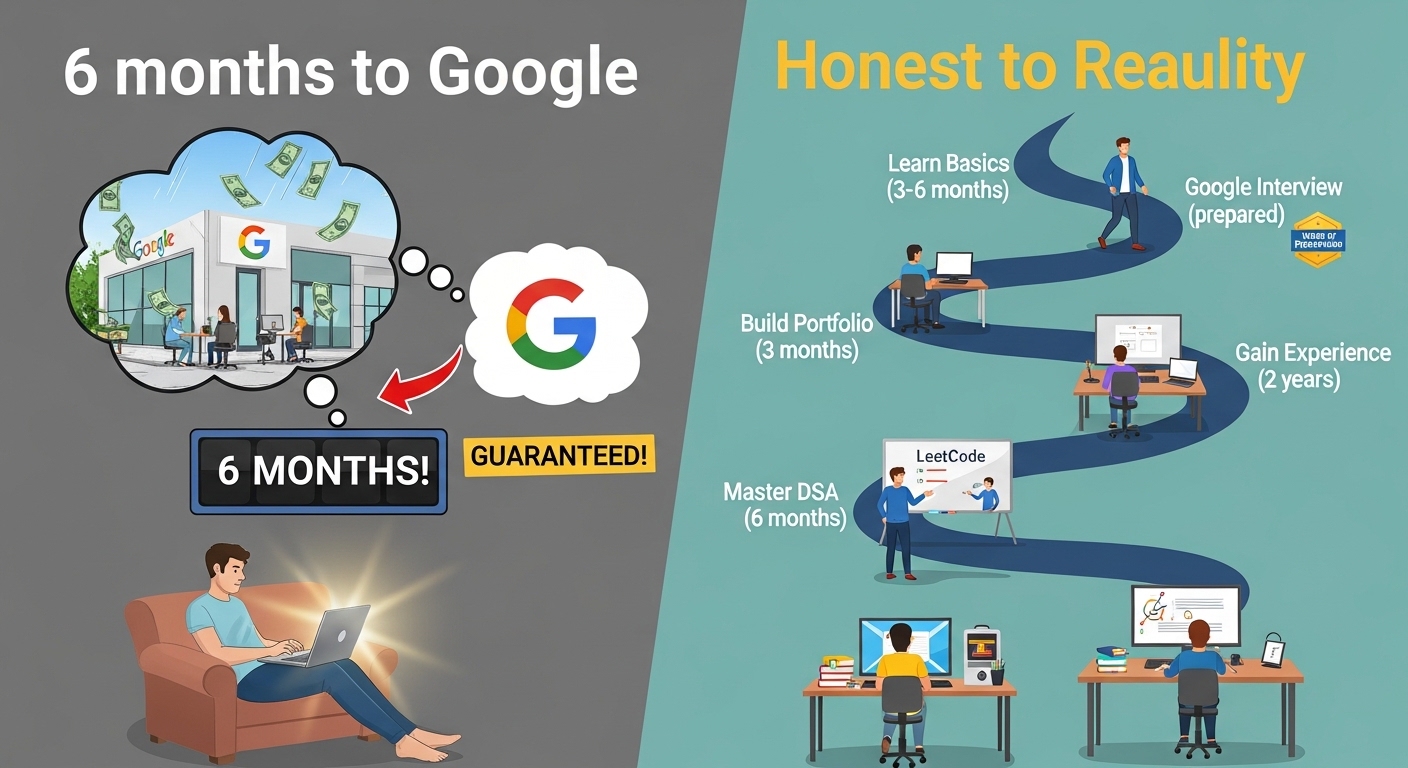
The Short Answer: Is 6 Months Realistic?
For most people, no. Getting a software engineering job at Google in 6 months starting from zero is extremely unrealistic.
For some people, maybe. If you have prior technical experience, can study full-time (40-60 hours/week), and are exceptionally gifted at problem-solving, you might have a shot at an entry-level role or apprenticeship.
The reality: Most successful Google hires have been preparing for years—through computer science degrees, years of coding experience, and months of dedicated interview practice .
But here’s the good news: You CAN make significant progress in 6 months. You might not land at Google, but you could land your first tech job, build a strong foundation, and position yourself for Google in 12-24 months.
Let’s break down exactly what it takes.
What Google Actually Looks For
The 0.2% Acceptance Rate
Google receives millions of applications annually—an estimated 2-3 million per year. The acceptance rate? Around 0.2% . That’s harder than getting into Harvard or Stanford.
Minimum Qualifications
For a software engineering role, Google expects :
- Bachelor’s degree in Computer Science or related field (or equivalent practical experience)
- Software development experience in languages like Java, C++, Python, JavaScript, or Go
- Strong understanding of data structures and algorithms
- Ability to solve complex problems under pressure
But here’s the important part: Google values skills over degrees. Laszlo Bock, Google’s former SVP of People Operations, famously said: “Grades are a little predictive your first two years, but for the rest of your career don’t matter at all” . They care about what you can DO, not which school you attended.
What They’re Really Assessing
Google’s hiring process evaluates four core attributes :
| Attribute | What It Means |
|---|---|
| Role-Related Knowledge | Can you do the job? Do you have the technical skills? |
| Cognitive Ability | How do you solve problems? How do you learn? |
| Leadership | Do you take initiative? Can you influence without authority? |
| “Googliness” | Do you fit the culture? Collaborative, curious, comfortable with ambiguity? |
The 6-Month Reality Check: What’s Actually Possible
The Brutal Truth from Someone Who Made It
Paden Gayle, now a Google software engineer, shares a humbling story. In 2020, he went into his first tech interviews and “failed horribly.” He was rejected by X (formerly Twitter), Bloomberg, and even a Google apprenticeship program. The next year, he received six offers—but Google still rejected him. It wasn’t until 2024, after three years at Bloomberg, that he finally got his Google offer .
His advice? “Interviewing, job hunting, all of it — it’s not a sprint. It’s really just a marathon, and that’s also in your preparation” .
What a Realistic 6-Month Timeline Looks Like
| Month | Focus | Expected Outcome |
|---|---|---|
| Month 1-2 | Learn programming basics (Python/JavaScript), build tiny projects | Comfortable with syntax, can write simple programs |
| Month 3-4 | Learn data structures & algorithms, start LeetCode (easy problems) | Can solve basic coding challenges |
| Month 5-6 | Build portfolio projects, learn version control (Git), apply for internships | Portfolio with 2-3 projects, maybe internship interviews |
Realistic goal after 6 months: Entry-level internship, junior developer role at a small company, or acceptance into an apprenticeship program. Not Google.
The Google Software Engineering Levels
Understanding Google’s career levels helps set realistic expectations :
| Level | Title | Experience | Typical Age |
|---|---|---|---|
| L3 | Software Engineer II | 0-1 years | Fresh graduate |
| L4 | Software Engineer III | 2+ years | After some experience |
| L5 | Senior Software Engineer | 5+ years | Experienced |
| L6+ | Staff and above | 8+ years | Very experienced |
Most hiring happens at L3 and L4 levels. Even for L3, Google expects equivalent practical experience—which usually means either a CS degree OR 1-2 years of professional development work .
The Google Interview Process: What You’d Face
Step 1: Resume Screening
Your resume must demonstrate:
- Strong computer science fundamentals
- Impact-driven project experience
- Measurable outcomes (e.g., “reduced latency by 40%”)
- Internship or prior engineering exposure
If you’re self-taught with no degree: Your projects and GitHub profile need to be exceptional.
Step 2: Recruiter Phone Screen
20-30 minute conversation about your background, role alignment, and expectations .
Step 3: Technical Phone Interviews
1-2 rounds of coding interviews (45 minutes each) focusing on data structures and algorithms. You’ll solve problems in real-time, often without an IDE .
Step 4: On-Site Interviews (4-6 rounds)
If you pass the phone screens, you’ll face :
- 2-3 technical coding rounds (algorithms, data structures)
- 1 system design round (for experienced candidates)
- 1 “Googliness” behavioral round (cultural fit)
- Lunch interview (informal, but still evaluated)
Step 5: Hiring Committee Review
This is unique to Google. No single interviewer decides. A separate committee reviews all feedback independently .
Step 6: Team Matching
If approved, you’re matched with a team that needs your skills .
Total time: 4-8 weeks typically .
The Skills You Need to Master
Technical Fundamentals
| Category | Topics |
|---|---|
| Programming Languages | Python, Java, C++, or JavaScript (master at least 2) |
| Data Structures | Arrays, linked lists, stacks, queues, trees, graphs, hash tables |
| Algorithms | Sorting, searching, recursion, dynamic programming, backtracking |
| System Design | Scalability, APIs, databases, caching (for experienced roles) |
| Tools | Git, Linux, debugging, testing |
LeetCode Expectations
A common roadmap shared by successful candidates :
| Difficulty | Problems to Solve |
|---|---|
| Easy | 100+ problems |
| Medium | 150+ problems |
| Hard | 50+ problems |
But quality matters more than quantity. As Paden Gayle emphasizes: “If someone asks you to solve a question using Algorithm A, make sure you understand why you’re using Algorithm A, and be able to explain what are the tradeoffs of it” .
The “Why” Matters More Than the “What”
Memorizing solutions won’t work. Google interviewers now ask problems you’ve likely never seen. They want to see your reasoning process, not your memory .
The Apprenticeship Route: A More Realistic Path
Google offers apprenticeship programs that are more accessible for newcomers.
Software Development Apprenticeship Example
Location: Dublin, Ireland
Duration: 24 months (includes 6 months offsite training)
Minimum qualifications:
- Passing grades in 5+ subjects (including Math and English)
- Experience coding in any programming language
- Fluency in English
What it offers:
- 6 months of training with educational partner
- Onsite rotations working alongside Google teams
- Exposure to coding, development, testing, and project management
This is a REAL entry point. If you can demonstrate basic coding ability and passion, apprenticeships provide structured pathways into Google without requiring a CS degree or years of experience.
The 12-Month Roadmap: A More Realistic Timeline
If you’re serious about Google, here’s what a more realistic preparation timeline looks like :
Phase 1: Foundation (3-6 months)
- Master 2 programming languages (Python + JavaScript or Java)
- Learn core data structures and algorithms
- Build small projects to apply learning
- Start LeetCode (easy problems)
Phase 2: Deep Practice (2-3 months)
- Daily coding practice (45-60 minutes)
- Solve medium LeetCode problems
- Learn system design fundamentals
- Study computer science basics (OS, networks)
Phase 3: Interview Prep (2-3 months)
- Mock interviews on Pramp or Interviewing.io
- Practice explaining solutions aloud
- Behavioral prep using STAR method
- System design deep dive (for experienced)
Phase 4: Application (1-2 months)
- Optimize resume with quantified achievements
- Get employee referrals (most effective!)
- Network with recruiters on LinkedIn
- Apply strategically
Total: 12-18 months for a competitive shot at Google.
Alternative Paths: Get a Tech Job FASTER
If your goal is to start earning as a developer sooner, consider these routes with higher placement rates :
| Path | Placement Rate | Timeline | Starting Salary |
|---|---|---|---|
| Google IT Support Certificate | 85% in 6 months | 3-6 months | $50K-$70K |
| Coding Bootcamps | 70-90% | 3-10 months | $55K-$120K |
| CompTIA Security+ (Cybersecurity) | Appears in 70% of job postings | 1-3 months | $60K-$100K |
| AWS Certified Solutions Architect | High demand in cloud | 2-4 months | $70K-$150K |
These won’t get you into Google directly, but they’ll get you into tech. From there, you can build experience and aim for Google later.
Success Stories: What Actually Worked
Paden Gayle’s Journey: Rejections → Growth → Google
Paden was rejected by Google twice. His strategy :
- Went back to master fundamentals, not just memorize solutions
- Practiced explaining his reasoning, not just coding
- Did one LeetCode problem daily for months—consistent, not intense
- Built genuine connections with recruiters (talked about music, not just jobs)
- Stayed in touch during hiring freezes
His advice: “If you’re not prepping for tomorrow, prep for a year from now. So when companies do start hiring, you’re ready” .
The Apprenticeship Success Story
A Code.X bootcamp graduate from Palestine completed a 6-month program, then secured a remote job with Google—earning 3x local salaries .
Key factors: Structured program, professional instruction, and demonstrated ability through projects.
Aashna Doshi’s Lessons After 6 Months at Google
An Indian-origin engineer at Google New York shared what helped her succeed once hired :
- Ask questions—senior engineers are generous with knowledge
- Build community—join groups, find your people
- Network continuously—schedule coffee chats weekly
- Take ownership—think beyond assigned tasks
- Communicate well—presenting ideas clearly sets you apart
- Keep learning—tech never stops evolving
The Honest Bottom Line
Can you get a job at Google in 6 months starting from zero?
Statistically, no. The acceptance rate is 0.2%, and most successful candidates have years of preparation.
Can you make significant progress toward that goal in 6 months?
Absolutely. You can:
- Learn programming fundamentals
- Build a portfolio of projects
- Master data structures and algorithms basics
- Start solving LeetCode problems
- Apply for apprenticeships or internships
- Position yourself for a real shot in 12-24 months
What should you actually do?
| If you’re… | Your 6-month goal should be… |
|---|---|
| Complete beginner | Learn basics, build first projects, apply for apprenticeships |
| Some coding experience | Master DSA, build portfolio, apply for internships |
| Experienced developer | Intensive interview prep, system design, referrals |
Your 6-Month Action Plan
Month 1-2: Learn to Code
- Choose Python or JavaScript (beginner-friendly)
- Complete free courses (CS50, FreeCodeCamp, The Odin Project)
- Code daily—even 30 minutes
- Build tiny projects (calculator, to-do app)
Month 3-4: Dive into DSA
- Study data structures (arrays, linked lists, trees, graphs)
- Learn algorithms (sorting, searching, recursion)
- Start LeetCode (easy problems, then medium)
- Understand time/space complexity
Month 5-6: Build & Apply
- Build 2-3 substantial portfolio projects
- Create GitHub repository with clean code
- Optimize LinkedIn and resume
- Apply to apprenticeships and internships
- Network with tech professionals
- Practice mock interviews
After 6 Months: Keep Going
- If you get an apprenticeship/internship → take it, gain experience
- If not → keep building, keep learning, keep applying
- Aim for Google in 12-24 months, not 6
The Final Truth
The “Learn coding in 6 months and get a job at Google” narrative sells dreams—and courses. But the reality is both harder and more hopeful.
Harder because: Google’s bar is extraordinarily high. You’re competing with CS graduates, experienced developers, and brilliant minds from around the world. Six months is rarely enough.
More hopeful because: You don’t need Google to have a successful tech career. Thousands of companies need developers. You can start smaller, gain experience, build your skills, and then aim for Google when you’re truly ready.
Paden Gayle’s journey says it all: rejected twice, worked at Bloomberg for three years, kept preparing, stayed connected, and finally got his Google offer. Not a sprint. A marathon.
Your 6 months aren’t wasted if you don’t get into Google. They’re the foundation of a career. Start building it today.
About the Author
