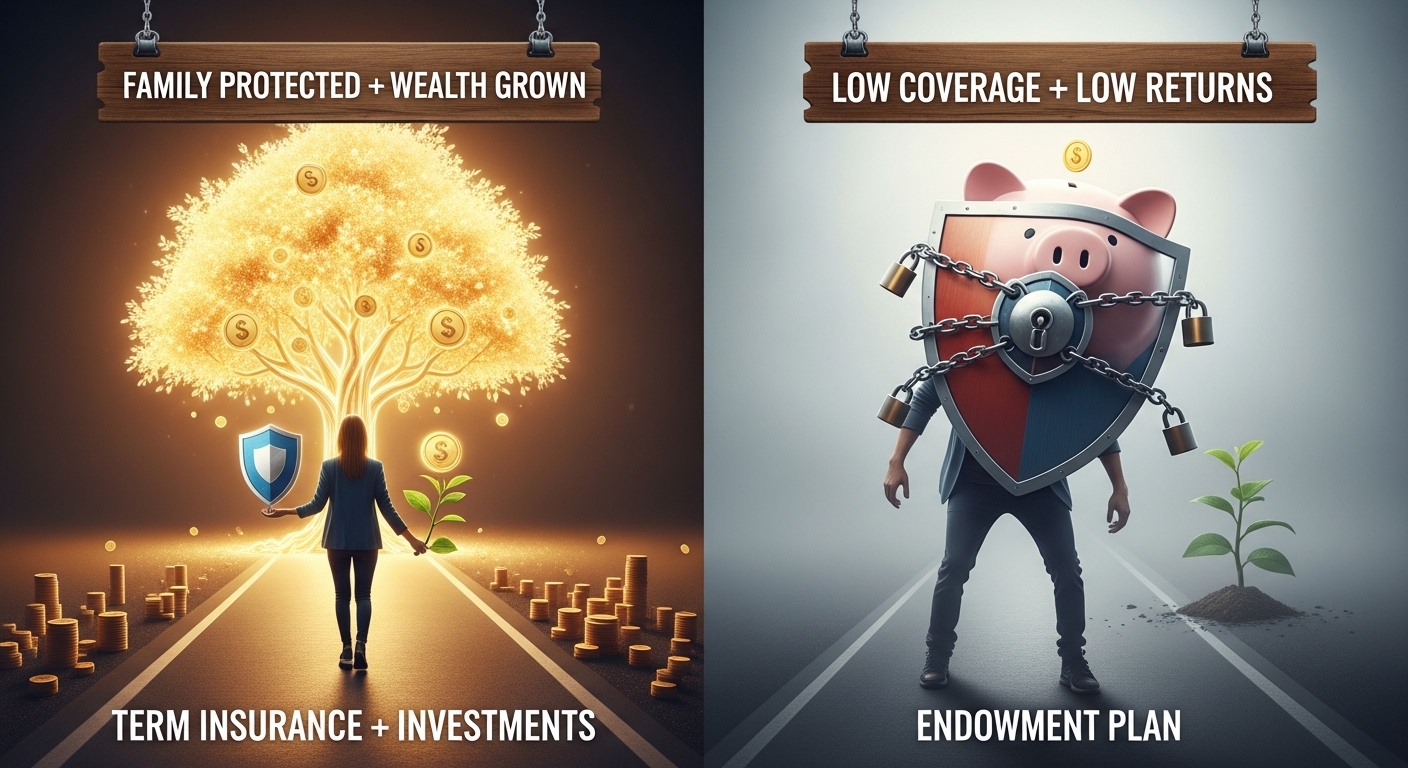
If you’ve ever tried to buy life insurance, you’ve probably faced this confusion:
Term Insurance: Pure protection. Low premium. No returns if you survive.
Life Insurance (Endowment/Whole Life/ULIP): Protection + savings/investment. High premium. Money back if you survive.
Insurance agents push the second option hard. “Why pay premiums and get nothing back?” they ask. “With our plan, you get protection AND your money back!”
It sounds logical. It feels satisfying. But is it actually good for your finances?
Let’s break down both options, compare them honestly, and help you decide which one truly belongs in your financial plan.
The Fundamental Difference
| Aspect | Term Insurance | Life Insurance (Endowment/Whole Life/ULIP) |
|---|---|---|
| What It Is | Pure protection | Protection + Savings/Investment |
| Premiums | Very low | Very high (5-10x term insurance) |
| Coverage | High (₹1 crore+) | Low relative to premium |
| Maturity Benefit | None | You get money back if you survive |
| Complexity | Simple and transparent | Complex with multiple components |
| Best For | Protecting dependents | ? (Very few situations) |
Option 1: Term Insurance — The Pure Protector
How It Works:
You pay a fixed premium every year. If you die during the policy term, your nominee receives the sum assured (e.g., ₹1 crore). If you survive the entire term, you get nothing back.
Example:
- Age: 30 years
- Term: 30 years (cover until 60)
- Sum Assured: ₹1 crore
- Annual Premium: ₹10,000-15,000
- If you die at age 55: Family gets ₹1 crore
- If you survive to 60: You get ₹0
The Pros:
1. Maximum Protection at Minimum Cost
For the same ₹1 crore coverage:
- Term insurance: ₹12,000/year
- Endowment plan: ₹85,000/year
That ₹73,000 difference can be invested elsewhere.
2. Simplicity
No complicated calculations. No “bonus” projections. No surrender values. Just pure protection.
3. Flexibility
You can choose exactly how much coverage you need and for how long. When your children become independent, you can reduce coverage or let it expire.
4. High Claim Settlement Ratio
Term plans from good companies have excellent claim settlement ratios because there’s no investment component to complicate things.
5. Tax Benefits
Premiums qualify for deduction under Section 80C. The death benefit is tax-free under Section 10(10D).
The Cons:
1. No Money Back
If you survive, you get nothing. Some people find this psychologically difficult—”I paid for 30 years and got nothing?”
2. No Cash Value
You cannot borrow against it. You cannot surrender it for money. It’s pure expense.
3. Premiums Increase with Age
If you buy at 40 instead of 30, premiums are much higher. If you develop health issues, you may become uninsurable.
Option 2: Life Insurance (Endowment/Whole Life/ULIP) — The Hybrid
How It Works:
You pay a high premium. Part goes toward insurance. Part goes into a savings/investment fund. If you die, your nominee gets the sum assured. If you survive, you get the accumulated amount (sum assured + bonuses/investment returns).
Types of Life Insurance Plans:
| Type | How It Works | Returns |
|---|---|---|
| Endowment Plan | Traditional plan with guaranteed additions | Low (4-6%) |
| Money Back Plan | Periodic payouts during policy term | Low (4-6%) |
| Whole Life Plan | Coverage until age 100, with cash value | Low to moderate |
| ULIP | Market-linked investments | Market-dependent (after fees) |
Example (Endowment Plan):
- Age: 30 years
- Term: 30 years
- Sum Assured: ₹15 lakhs
- Annual Premium: ₹85,000
- If you die: Family gets ₹15 lakhs + bonuses
- If you survive: You get ₹20-25 lakhs (assumed)
The Pros:
1. Money Back If You Survive
You don’t feel like you “wasted” money if you outlive the policy.
2. Disciplined Saving
For people who cannot save otherwise, the forced premium payment builds a corpus.
3. Guaranteed Returns (in traditional plans)
You know exactly what minimum amount you’ll get.
4. Loan Facility
You can borrow against the policy’s surrender value.
The Cons:
1. Very High Premium, Very Low Coverage
For the same premium as term insurance, you get 10-20% of the coverage.
2. Poor Returns
Traditional plans typically return 4-6%—less than bank FDs. After inflation, you’re losing purchasing power.
3. Complex and Opaque
Understanding what you’re actually getting—especially with bonuses and projections—is nearly impossible.
4. High Hidden Charges (ULIPs)
In early years, most of your premium goes to commissions and charges, not investment.
5. Lock-in Period
You cannot withdraw for 5 years in ULIPs. Surrendering early means heavy losses.
6. Inflation Eats Returns
₹20 lakhs after 30 years will be worth far less than today due to inflation.
The Math: Which One Makes You Richer?
Let’s compare two people, both age 30, both with ₹1 lakh annual budget for protection + investment.
Person A: Term Insurance + Separate Investments
- Term insurance (₹1 crore cover): ₹12,000/year
- Remaining ₹88,000 invested in diversified mutual funds
- Expected return: 10-12%
Person B: Endowment Plan
- Endowment plan (₹15 lakhs cover): ₹85,000/year
- Remainin₹15,000 in FD (for fairness)
After 30 Years (Age 60):
| Scenario | Person A | Person B |
|---|---|---|
| Insurance Coverage | ₹1 crore (throughout) | ₹15 lakhs (throughout) |
| Investment Corpus (at 10%) | ₹1.60 crore | ₹0 (from policy) + ₹30 lakhs from FD |
| Total Wealth | ₹1.60 crore + ₹1 crore coverage | ₹30 lakhs + ₹15 lakhs coverage |
| If died at 55 | Family gets ₹1 crore + ₹1.10 crore investments = ₹2.10 crore | Family gets ₹15 lakhs + ₹25 lakhs investments = ₹40 lakhs |
Person A ends up with 5x more wealth than Person B, despite having the same annual outlay.
The “But I Get Money Back” Myth
Insurance agents exploit a psychological bias: loss aversion. We hate losing money more than we love gaining it.
“With term insurance, you lose all your premiums if you survive,” they say.
But here’s what they don’t tell you:
With term insurance, you’re not “losing” money. You’re paying for protection, just like you pay for:
- Car insurance (you get nothing back if no accident)
- Health insurance (you get nothing back if no hospitalization)
- Home insurance (you get nothing back if no fire)
Would you buy a “car insurance + savings” plan that costs 5x more and returns your premiums after 30 years? Probably not. So why accept it for life insurance?
The Truth About “Bonuses” in Traditional Plans
Insurance companies love showing “bonus” projections. Here’s what they don’t explain:
| Term | What It Means | Reality |
|---|---|---|
| Simple Reversionary Bonus | Amount added per ₹1,000 sum assured | ₹40-50 per ₹1,000 annually = 4-5% return |
| Terminal Bonus | Additional bonus at maturity | Not guaranteed, paid only if company profits high |
| Guaranteed Addition | Fixed amount added | This is the only certain part—and it’s small |
Example:
Sum assured: ₹10 lakhs
Annual bonus: ₹50 per ₹1,000 = ₹50,000 per year
After 20 years: ₹10 lakhs guaranteed + ₹10 lakhs bonus = ₹20 lakhs
But: You paid ₹50,000-60,000 annually for 20 years = ₹10-12 lakhs premiums
Effective return: 4-5%
Meanwhile, even a bank FD would have given you 6-7%.
When Does Life Insurance (Hybrid) Make Sense?
Despite the math, there are specific situations where traditional life insurance might be appropriate:
1. You Absolutely Cannot Trust Yourself to Save
If you know with certainty that you will spend the difference instead of investing it, a forced savings plan might be better than nothing. But this is a psychological failure, not a financial optimization.
2. You Need Very Long-Term, Guaranteed Returns
For obligations 20-30 years away where you cannot take market risk, the guaranteed portion of endowment plans provides certainty—albeit low returns.
3. You Have Estate Planning Needs
Whole life insurance can be useful for ultra-high-net-worth individuals to pass wealth to next generation tax-efficiently.
4. You Want to Balance a Portfolio
Some advisors recommend a small allocation to guaranteed products for stability. But this should be a tiny part of your portfolio.
5. You’ve Maxed All Other Tax-Advantaged Investments
If you’ve already maxed PPF, EPF, ELSS, and still want more 80C deductions, endowment plans can be considered—but only after calculating actual returns.
Side-by-Side Comparison: Which Should You Choose?
| Your Situation | Term Insurance | Life Insurance (Hybrid) |
|---|---|---|
| You have young children | ✅ BEST | ❌ Avoid |
| You have a home loan | ✅ BEST | ❌ Avoid |
| You have dependents | ✅ BEST | ❌ Avoid |
| You’re young (20-40) | ✅ BEST | ❌ Avoid |
| You’re disciplined with investments | ✅ BEST | ❌ Avoid |
| You cannot save without force | ⚠️ Still better with separate SIP | ✅ Maybe consider |
| You want guaranteed returns | ❌ No guarantee | ✅ Guaranteed (but low) |
| You have maxed all other investments | ✅ Still best | ⚠️ Can consider small allocation |
| You’re over 50 with no dependents | ❌ Not needed | ❌ Not needed (health insurance more important) |
| You want to leave legacy | ✅ Term + investments | ⚠️ Whole life for ultra-rich |
The Ideal Strategy: Buy Term, Invest the Difference
Financial planners almost universally recommend this approach:
Step 1: Buy Adequate Term Insurance
- Calculate coverage: 15-20x annual income + loans + future goals
- Buy pure term plan from company with >95% claim settlement ratio
- Choose term until retirement age (60-65)
Step 2: Invest the Difference
- Take the money you saved by not buying expensive life insurance
- Invest in a mix of:
- Equity mutual funds/index funds (for growth)
- PPF/EPF (for tax-free, guaranteed returns)
- Debt funds/FDs (for stability)
- Use SIPs for disciplined investing
Step 3: Review and Adjust
- Every 5 years, review coverage needs
- Increase term coverage if income increased significantly
- Adjust investment allocation as you age
The Agent’s Argument vs. The Reality
| What Agent Says | The Reality |
|---|---|
| “You get nothing back with term insurance” | You get protection—that’s what you’re paying for |
| “Our plan gives returns AND protection” | Returns are poor, protection is inadequate |
| “Bonuses make it attractive” | Bonuses are 4-5%—less than inflation |
| “Tax benefits under 80C” | Term insurance also gives 80C benefits |
| “Loan available against policy” | Borrowing against insurance is expensive—better to have emergency fund |
| “Forced savings helps” | Set up auto-SIP for same effect, better returns |
Real-Life Example: Same Money, Different Outcomes
Rahul and Priya are both 30 years old. Both have ₹1 lakh annual budget for insurance + savings.
Rahul (Term + Investments):
- Term insurance: ₹1 crore cover @ ₹12,000/year
- Invests ₹88,000/year in diversified mutual funds
- At 60: Investment corpus ~ ₹2.1 crore (at 12% returns)
- Plus ₹1 crore cover (if needed earlier)
Priya (Endowment Plan):
- Endowment plan: ₹20 lakhs cover @ ₹85,000/year
- Balance ₹15,000/year in FD
- At 60: Gets ₹30-35 lakhs from policy + ₹5 lakhs from FD
- Total: ~₹40 lakhs
Difference at age 60: ₹1.7 crore
That’s the cost of choosing the wrong product.
Common Questions Answered
Q: What if I outlive my term insurance? Won’t I have wasted money?
A: Would you say you “wasted” money on car insurance because you didn’t have an accident? Insurance is for protection, not returns. The peace of mind that your family is protected is the return.
Q: Aren’t ULIPs better now with new regulations?
A: New ULIPs have lower charges than before, but they still mix insurance and investment. You’re almost always better with term + separate mutual funds.
Q: My agent says term insurance companies don’t pay claims.
A: Check claim settlement ratios on IRDAI website. Top term insurance companies have >95% settlement ratios. Many “life insurance” companies have lower ratios because of complex products.
Q: What about children’s plans that give money when they turn 18?
A: Same logic applies. Buy term insurance on your life (to protect the child if something happens to you) and invest separately for their education. Better returns, more flexibility.
Q: I’m older now (45+). Is term insurance still better?
A: Yes, but premiums will be higher. Calculate if it’s worth it. If you have no dependents, you may not need either. If you do, term is still better.
The Bottom Line: Your Decision Framework
Choose Term Insurance IF:
- You have people financially dependent on you
- You want maximum coverage at minimum cost
- You can invest separately (even if just in PPF/EPF)
- You understand insurance = protection, not investment
- You’re under 50 and reasonably healthy
Consider Life Insurance (Hybrid) IF:
- You have tried and failed to save for 10+ years (and accept the lower returns as “discipline cost”)
- You have maxed all other tax-saving investments and still want more 80C deduction
- You need guaranteed returns for a specific future liability (rare)
- You’re ultra-wealthy and need estate planning tools
- You fully understand the returns and accept them
For 95% of People:
Term insurance + separate investments is mathematically superior.
Your Action Plan
- Calculate your term insurance need: 15-20x annual income + loans + future goals
- Buy term insurance online from a company with high claim settlement ratio. Don’t buy from agents pushing expensive plans.
- Review existing life insurance policies:
- List all endowment/ULIP/whole life policies
- Calculate returns using XIRR in Excel
- Decide: surrender or continue based on:
- Policy age (surrender early if new)
- Guaranteed returns vs. alternative returns
- Tax implications
- Start separate investments:
- Set up SIP in diversified mutual funds
- Contribute to PPF/EPF
- Build emergency fund
- Review annually:
- Is your term coverage still adequate?
- Are investments on track?
- Any new dependents? Increase coverage.
Final Wisdom
Insurance agents will always push expensive products because they earn high commissions (up to 40% of first-year premium) on endowment plans and ULIPs. On term insurance, their commission is tiny.
Follow the money. The product that agents push hardest is usually the one that’s best for them, not for you.
Remember: Insurance is to protect your family if you die. Investments are to build wealth while you live. Mixing them creates a product that does both poorly.
Keep them separate. Buy term insurance. Invest the difference. Watch your wealth grow while your family stays protected.
That’s not just financial wisdom—it’s peace of mind.
About the Author
