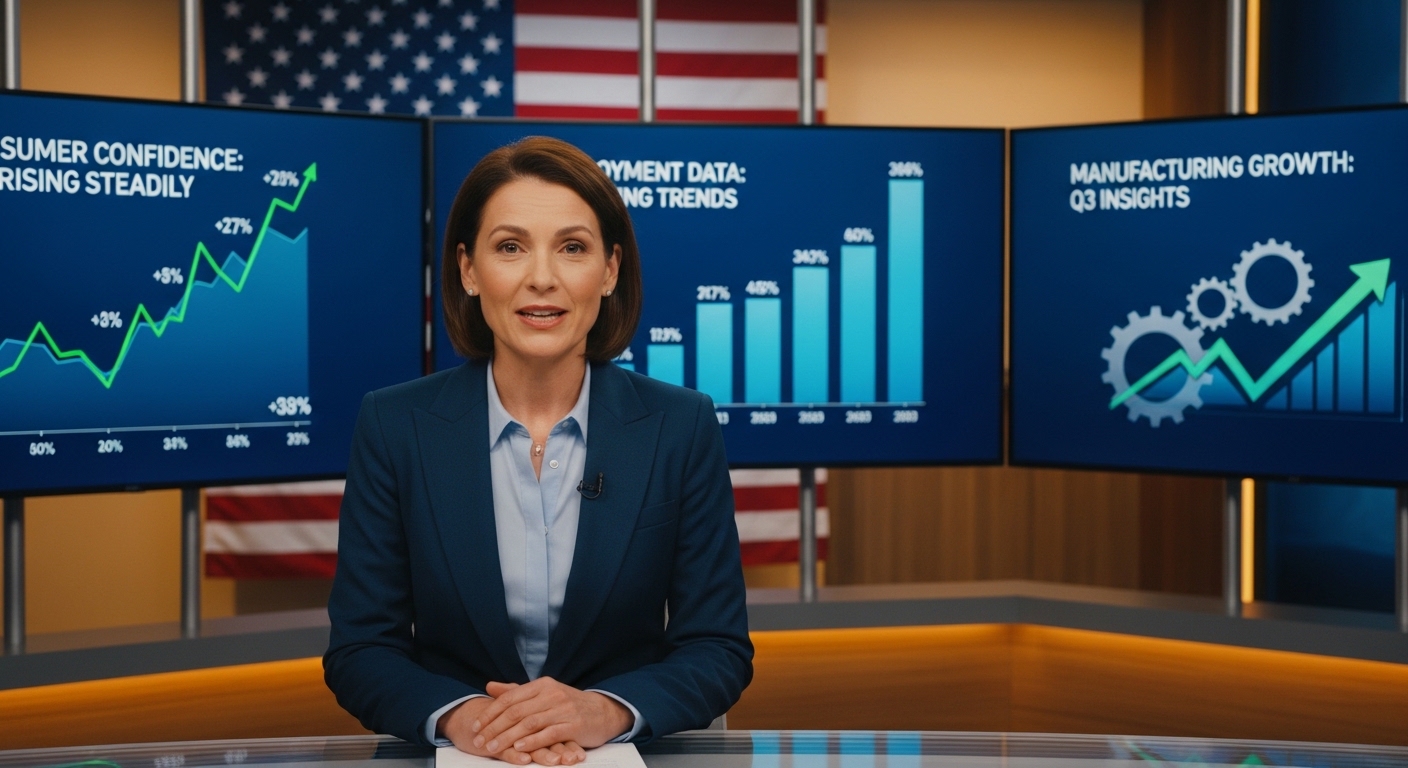
As President Donald Trump prepares to deliver his State of the Union address, fresh economic data is offering a timely boost to the White House narrative: the U.S. economy appears stronger than many critics expected.
Recent figures show a sharp rise in consumer confidence, notably among independent voters—a key demographic that often reflects broader economic sentiment beyond party lines. Expectations about jobs and income prospects have improved, signaling growing optimism about the months ahead. Even traditionally skeptical outlets have acknowledged that the economy is performing better than anticipated, despite lingering political debate over its long-term direction.
Consumer Confidence and the Labor Market
Speaking on the data, Nancy Lazar, Chief Global Economist at Piper Sandler, emphasized that while daily headlines may highlight uncertainty, underlying trends point toward stability and improvement.
According to Lazar, consumer confidence has been on an upward trajectory since October, a trend reinforced by recent Conference Board data. Importantly, the job market appears to be loosening just enough to benefit workers. Unemployment claims remain historically low, and job availability has modestly improved—an encouraging sign after months of tight labor conditions.
She also highlighted the critical role of small businesses, which account for the vast majority of job creation in the United States. While Wall Street tends to focus on large corporations, it is smaller firms—those with fewer than 500 employees—that are feeling increasingly confident about hiring and expansion.
Ending the “Two-Speed” Economy
One of the most notable shifts discussed was the potential end of the so-called “K-shaped” economy, where high-income households prospered while lower-income groups struggled. Lazar suggested that this economic bifurcation may gradually fade through 2026 as job growth broadens and wage stability improves.
Tax refunds, while helpful, are not the sole driver of this optimism. A healthier labor market, combined with easing financial conditions, is beginning to lift confidence among middle- and lower-income consumers—groups that are essential for sustaining long-term economic growth.
Manufacturing Renaissance Gains Momentum
The manufacturing sector is also showing renewed strength. Key indicators such as factory orders and purchasing managers’ indexes have turned upward, suggesting that the long-discussed manufacturing revival may be gaining real traction.
Lower interest rates, combined with strong fiscal incentives—particularly full and immediate capital expenditure depreciation—are encouraging companies to invest in domestic production. These policies have made onshoring more attractive, leading to new factory construction and industrial expansion across several states.
AI, Jobs, and Economic Growth
Concerns remain around artificial intelligence and job displacement, particularly in white-collar sectors like software development. However, Lazar dismissed fears of a widespread employment crisis, arguing that technological innovation historically replaces old roles with new ones.
While some job categories may shrink, overall employment tends to grow as productivity increases and new industries emerge. She noted that blue-collar job growth, often overlooked in market discussions, has been particularly strong—an encouraging sign for long-term economic balance.
Outlook
Despite surface-level volatility driven by politics, tariffs, and technological change, the broader economic picture appears to be stabilizing and even strengthening. Rising consumer confidence, improving labor conditions, renewed manufacturing investment, and resilient small businesses suggest that the U.S. economy is entering a healthier phase.
As the State of the Union approaches, these trends provide important context: beneath the noise, the fundamentals are showing signs of durable progress.
About the Author
